
Grundy's knockout punch

I had a unique viewing experience for the final ruck contest of Port v Sydney last weekend. I tuned in for the first time as the replay of Jordon Sweet’s goal was playing. After watching Sweet win the centre tap and Grundy ice the game with his stoppage knock I went back to watch the rest of the game for some context.
Brodie Grundy did what in almost every instance you’d think was an error for the ruck on the leading team with 20 seconds left - he punched it into space. Yet it was undeniably the right call here.
Grundy has more experience being on the opposite end of things - delivering a pivotal hitout setting up the go ahead goal with minutes or seconds left on the clock. Joe Cordy wrote about it in Extra Time for the Round 14 edition of This Week In Football.

Chasing a lead is fighting against inevitability. The chasing team needs to create disruption, the leading team can simply sit and wait. As the clock approaches zero, efforts to disrupt the game become more and more desperate.
A kicking option that would be pilloried in the first quarter becomes the only reasonable option in the final minute. The kick hasn’t changed, but we no longer judge it against the high risk of turnover but instead against the inevitability of the clock.
The harsh reality is that in these scenarios the right choices and even the right execution frequently won’t lead to the desired result. That doesn’t invalidate the process, it’s merely a consequence of playing with a weighted deck.
The purest example is pulling the goalie in ice hockey. When trailing, a team may choose to pull their goalie off the ice and replace them with an extra attacker.
By far the most common result of this is conceding another goal and going behind further. But the chance of levelling the game also goes up.
The leading team want to minimise disruption to the game state. In football the ideal is a series of uncontested marks. Every mark takes a few seconds off the clock with no chance of the opponent gaining possession.
Failing that they’ll maximise stoppages. Every second between the ball being effectively dead and the clock actually being stopped is a gift.
What happens when you get to a stoppage? You try to turn it into a repeat stoppage. The ruck of the leading team taps it down close and allows players to collapse in on the ball and prevent it from emerging.
The trailing ruck meanwhile wants to either hit it to the direct advantage or just punch it into space where disruption lives.
That’s not what happened here though.
The final stoppage had 18 seconds left on the clock. The players wouldn’t have known exactly how long, but there was a centre ball-up immediately beforehand so they could guess there’s time for a short passage of play, rather than Port needing a tap and immediate snap to beat the clock.
There’s also the context of how prior ruck contests played out.
For the below chart, where a hitout was recorded, that ruck’s picture is shown, and an asterisk denotes a hitout to advantage. The Y axis is just the order of stoppages and centre bounces through the match, the X axis represents territory advantage to either team at the point of stoppage and at the end of the subsequent possession chain. I encourage you to use the interactive version here though.
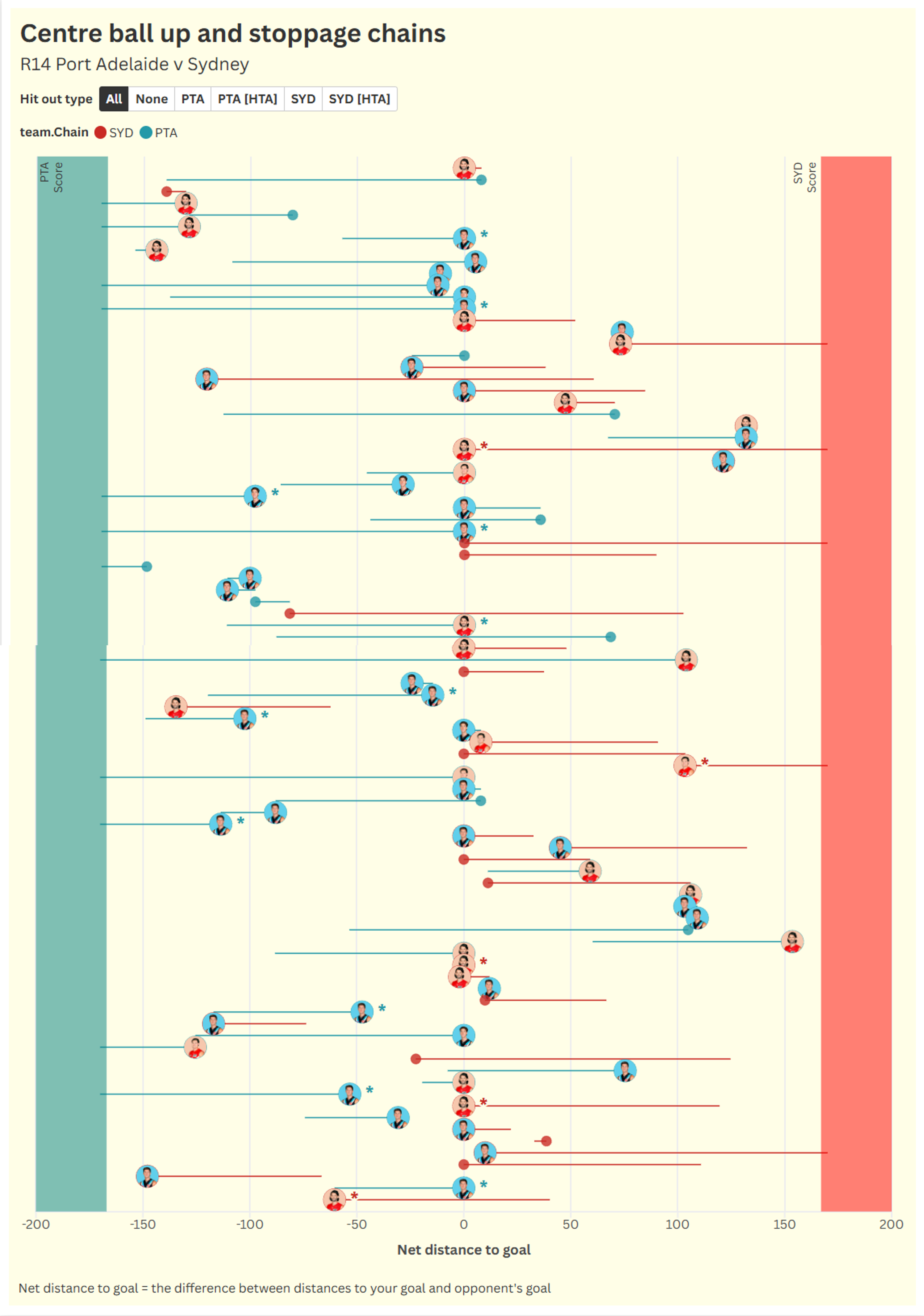
Of the past seven ruck contests, Sweet had the hitout in five of them including a HTA to butters immediately prior, with the other two having no hitout recorded. We have to go back a full 12 minutes to when Grundy last won a tap.
However, we can also see that of Sweet’s five last hitouts, Sydney took possession from three of them including scoring a goal off one. This trend was present through the night. While HTA’s gained significant territory, the remaining hitouts on balance lost territory for their team.
Overall though, Port were enjoying an advantage from stoppages. They’d scored 6.6 to Sydney’s 3.2, were up in hitouts to advantage 10-6, and were converting hit outs to first possessions and first possessions to clearances at a higher rate, leading to a 27-17 stoppage clearance differential.
Port had the advantage both in pre-clearance equity and ball use equity while trailing in post-clearance and ball winning (a relative rarity, about 10% of games in total).
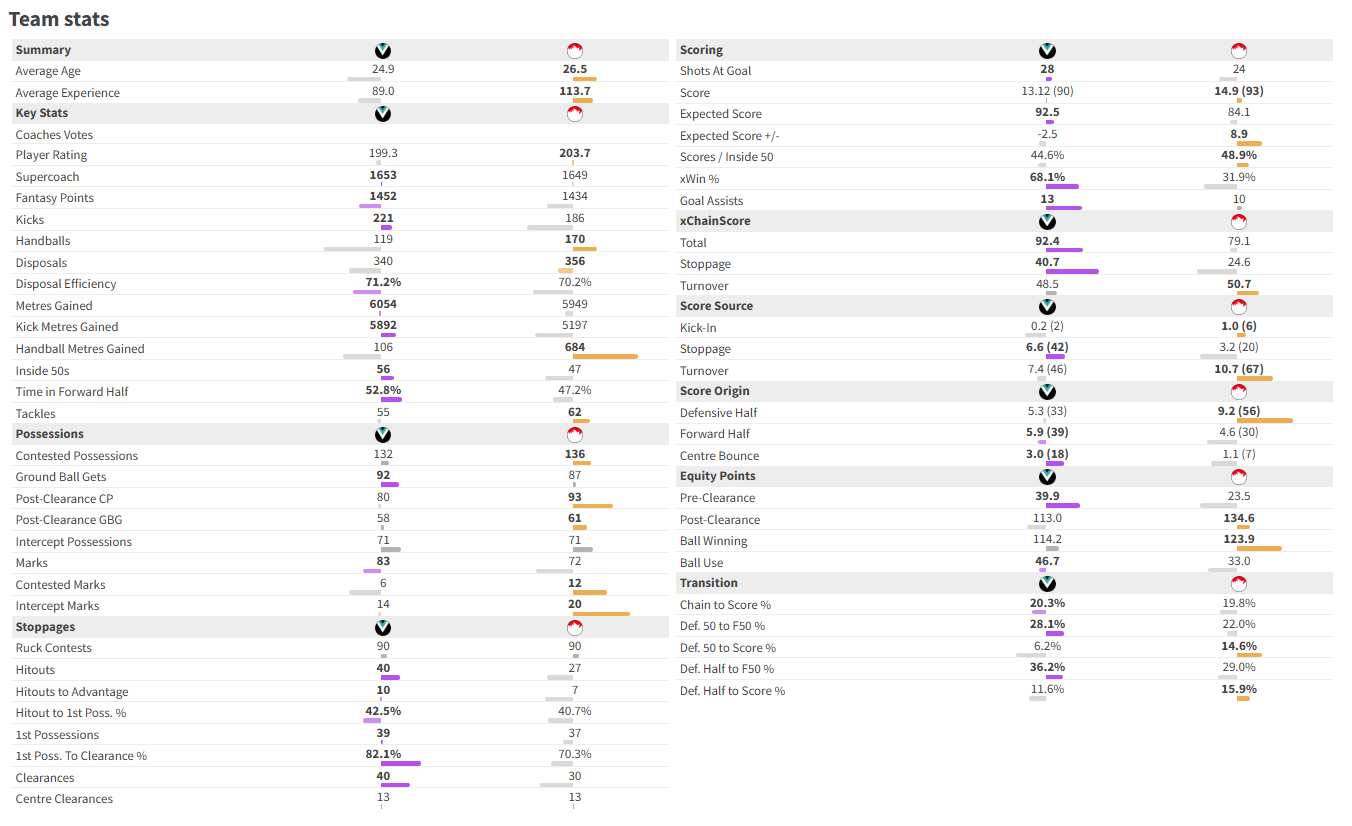
Sydney was winning their share more through intercept. Here they didn’t have that luxury though, the ball was already at the forward 50, if Port won possession a shot was likely.
Conventional wisdom: keep it in close and burn the clock with a repeat stoppage. However we need to remember why that’s the conventional wisdom: minimising the chance of disruption.
With Port so strong at stoppage, including feeding off Sydney’s hitouts, the best chance to avoid disruption was to deny Port the chance to contest the ball at all. Rather than keeping it in tight where the likes of Butters and Richards would be lurking, Grundy aimed to punch it far and wide to a spot that avoids the contest entirely. It was helped by the fact that Port, by necessity, had numbers stacked closer and preparing to run through the stoppage area to keep driving the ball forward. If Grundy could just get it to the outside the Sydney defenders would have a clear advantage.
From Port’s perspective, could they have planned anything to counter this?
Not really. Grundy has a really good tap zone, if he beat Sweet he would have a wealth of options to hit it to and Port couldn’t realistically cover them. Port couldn’t afford to think about what happens if Grundy wins a clean tap, they had to pull the goalie and hope that Sweet at least neutralises Grundy, if not wins a good tap himself.
It wasn’t even a bad bet, Grundy had just 5 HTAs to Sweet’s 9 at that point of the game.
Both teams came in with a really clear and defensible plan to maximise their chance of winning.
Yet again though, Grundy pulled the trump card at the end of a match. The punch went out beyond the width Port had set up to allowing Sydney’s defenders to move through and collect.
The first time Port had a chance to contest the ball was Aliir going for a spoil on the back corner of the centre square. It was the right choice, a mark would have slowed things down even further, but there was only six seconds left. The possibility space had collapsed to zero.
While writing this, Cody Atkinson and Sean Lawson published a great piece on close game scenarios for the ABC. Read it here.